
Introduction
The global prevalence of functional chronic constipation (CC), according to the Rome IV criteria, is 11.7%, and refractoriness to pharmacological treatment is reported in approximately 36% of cases. This lack of response could be attributed primarily to the presence of defecation disorders (DD), whose prevalence in CC is estimated at around 40%, and to a lesser extent to rectal hyposensitivity and slow colonic transit, with prevalences of 25% and 20.8%, respectively.1–3 Therefore, evaluation through functional digestive testing in refractory CC is essential to establish targeted management based on a pathophysiological classification.4,5
The treatment of choice for CC secondary to DD is anorectal biofeedback therapy (ABT), an intervention based on an instrumental rehabilitation process aimed at training the motor and sensory function of the posterior pelvic floor structures through techniques instructed and supervised by the operator, with a foundation of auditory, visual, and sensory rehabilitation.6 ABT can be administered using anorectal manometry (ARM) or electromyography, and both office-based and home-based modalities exist. The number of sessions typically ranges from four to six, and in selected cases, annual reassessment with reinforcement sessions may be recommended.6–8
The technique employed within the pelvic rehabilitation algorithm is individualized according to the pathophysiological mechanisms identified during functional pelvic floor evaluation and may include coordination exercises, muscle strengthening, or sensory rehabilitation.6,9 Adjuvant measures may occasionally be required, such as posterior tibial nerve electrostimulation or intracavitary electrostimulation.4,10,11 ABT always begins with education about defecation physiology, the pathophysiological mechanism of CC in each patient, and recommendations for daily life aimed at its management. As a complement to the sessions, home reinforcement exercises are also prescribed.6,7
The effectiveness of ABT in DD ranges from 60% to 80%, and in the case of ABT with sensory rehabilitation for rectal hyposensitivity, from 56% to 81%.12–14
Physiology of defecation
Understanding the mechanism of action of ABT and the individualized planning of therapy for patients with CC secondary to DD requires a thorough knowledge of defecation physiology and the underlying pathophysiological mechanism.
Continence and the dynamics of defecation require the anatomical and functional integrity of the pelvic floor structures, adequate contractile strength of the muscular structures, appropriate function of pelvic innervation, and correct motor coordination.15
The components that influence continence include the levator ani muscle complex, the internal anal sphincter (IAS), and the external anal sphincter (EAS), as well as adequate rectal capacitance and sensitivity. The levator ani muscle complex forms a diaphragmatic dome-shaped structure of the pelvic floor, capable of descending during the defecation maneuver. Among its components is the puborectalis muscle, a horseshoe-shaped muscle that surrounds the rectum and, at rest, serves a containment function by generating a rectal angle of 90-110°, mediated by its baseline contractile tone; this angle increases to approximately 120° with its relaxation during defecation. Regarding anal sphincter tone, approximately 70% is determined by the IAS and 30% by the EAS, while contractility depends primarily on the EAS.15–17
The physiological sequence of defecation begins with rectal distension and sensitivity, mediated by splanchnic nerves from the roots of the thoracolumbar dorsal root ganglia (T10-L1) and by lumbosacral pelvic nerves (L6-S1), which communicate with regions of laminae I and V of the spinal cord. Once the rectum becomes sensitized to fecal content, a rectoanal inhibitory reflex is induced with relaxation of the IAS, generating the urge to defecate. This is followed by voluntary abdominal contraction, together with relaxation of the puborectalis muscle and the EAS, generating a positive rectoanal gradient that promotes expulsion of fecal content.15,18
Pathophysiological mechanism of chronic constipation secondary to pelvic floor disorders
Primary CC secondary to pelvic floor pathology may be due to structural pelvic floor pathology, DD, or rectal hyposensitivity. With respect to structural pathology, the most common cause is pelvic organ prolapse, which produces an alteration in rectal distensibility or an obstructive component, as occurs in rectocele, cystocele, hysterocele, and enterocele.5
Regarding DD, the mechanism may correspond to a defect in the propulsion system, secondary to the isolated or combined presence of poor abdominal contraction, inadequate pelvic descent, and incomplete anal sphincter relaxation. Alternatively, it may result from dyssynergic defecation, in which there is paradoxical contraction of the anal sphincter during the defecation maneuver.5,9,15,19
Rectal hyposensitivity is probably the least-studied mechanism and, as its name indicates, corresponds to a pelvic floor disorder in which the rectal sensory threshold is elevated. This results in inadequate defecatory perception and, consequently, an inability to properly initiate the dynamics of defecation.9,20
Principles of anorectal biofeedback therapy
ABT is an intervention based on an instrumental rehabilitation process aimed at training the motor and sensory function of the posterior pelvic floor structures, through techniques instructed and supervised by the operator, with a foundation of auditory, visual, and sensory rehabilitation. ABT can be performed with the support of ARM or electromyography.6
The ABT protocol consists of three phases. During the first phase, a directed interview is conducted focusing on lifestyle habits and defecation symptoms, with the aim of understanding the biopsychosocial behavior of the patient and the clinical characteristics of their condition. At this stage, a weekly symptom diary is also provided, which will be assessed throughout the follow-up timeline. In addition, general advice for CC management is explained to the patient, including postural and ergonomic recommendations for defecation, the time interval between the urge to defecate and the defecation maneuver, as well as training in diaphragmatic breathing exercises and performance of a digital anorectal physical examination.6,7
During phase 2, or the active phase, ABT is formally initiated, with sessions lasting approximately 60 minutes. In these sessions, using ARM or electromyography, the patient can visualize on a screen the dynamic changes in the posterior pelvic floor structures, while the operator provides verbal instructions for maximum voluntary contraction, sustained voluntary contraction, and the straining maneuver. In this way, the patient is able to observe and understand their baseline poor coordination and correct the inappropriately performed maneuvers, under the verbal guidance of the operator and their own visual self-assessment through the instrument.7
Sessions are scheduled at 2-week intervals, with instructions to perform at home the pelvic rehabilitation exercises learned during the operator-directed sessions. Clinical and physiological response is assessed at the fourth session, at which point discontinuation of the sessions may be considered upon a successful therapeutic response, or extension of ABT up to six sessions, at which point treatment is concluded as either successful or unsuccessful.6,7
Phase 3 consists of optional reinforcement according to the patient’s characteristics, and reinforcement sessions may be recommended at 3, 6, and 12 months after completing the ABT protocol, as needed7 (Table 1).
Table 1. Phases of anorectal biofeedback therapy
| Phase 1: Initial assessment, planning, and education |
|---|
| Directed interview focused on anorectal symptomatology and quality of life |
| Digital anorectal examination |
| Education on CC pathophysiology |
| Defecation-related symptom diary |
| Education on general measures for CC management |
| Diaphragmatic breathing exercises |
| Individual ABT planning |
| Phase 2: Active |
| Four to six directed ABT sessions with ARM or EMG, spaced 2 weeks apart |
| If balloon rehabilitation is indicated, it will be provided during the scheduled sessions |
| If posterior tibial electrostimulation is indicated: 30 minutes per session, two or three times per week for 6-12 weeks |
| Phase 3: Reinforcement |
| Consider one reinforcement session at one month, and at 3 and 6 months |
| Annual assessment with ARM or EMG to evaluate the persistence of clinical and physiological response |
|
CC: chronic constipation; EMG: electromyography; ARM: anorectal manometry; ABT: anorectal biofeedback therapy. |
Indications, contraindications, and treatment plans for anorectal biofeedback therapy
Pelvic floor rehabilitation with ABT is indicated in patients who meet the diagnostic criteria for functional defecation disorders according to Rome IV. To establish this diagnosis, the patient must fulfill the criteria for CC or irritable bowel syndrome with predominant constipation, and additionally, during repeated defecation attempts, evidence of altered evacuation must be demonstrated in at least two of the following three tests: an abnormal balloon expulsion test, an abnormal anorectal evacuation pattern on ARM or surface anal electromyography, or an abnormal defecography with contrast retention ≥ 50%. These criteria must have been present during the last 3 months, with symptom onset at least 6 months before diagnosis.4,6,19
Within this group, two subcategories are recognized. The first corresponds to functional defecation disorders with inadequate propulsion, defined by the presence of inadequate propulsive forces measured by ARM, with or without inappropriate contraction of the anal sphincter or pelvic floor muscles, according to normal values appropriate for age and sex based on the technique used. The second subcategory corresponds to dyssynergic defecation, characterized by paradoxical contraction of the pelvic floor, measured with surface anal electromyography or ARM, in the presence of adequate propulsive forces during the defecation attempt, likewise defined according to normal values appropriate for age and sex based on the technique employed. In both subcategories, clinical and physiological criteria must have been met during the last 3 months, with symptom onset at least 6 months before diagnosis.
ABT in dyssynergic defecation is aimed at correcting the phenomenon of paradoxical anal sphincter contraction during the defecation maneuver, which has a predominantly behavioral basis and therefore shows a very good response to this intervention. In contrast, in the case of inadequate propulsion, ABT is oriented toward correcting the deficient propulsive force by reinforcing abdominal contraction during the straining maneuver or by attempting to correct incomplete anal sphincter relaxation during defecation. However, unlike paradoxical contraction per se, this phenomenon of incomplete relaxation, previously described in type III and IV dyssynergia in Rao’s classification, does not always have a correctable behavioral component, which partly explains why these patients tend to respond less to ABT than those with dyssynergic defecation4,6,19,21 (Fig. 1).
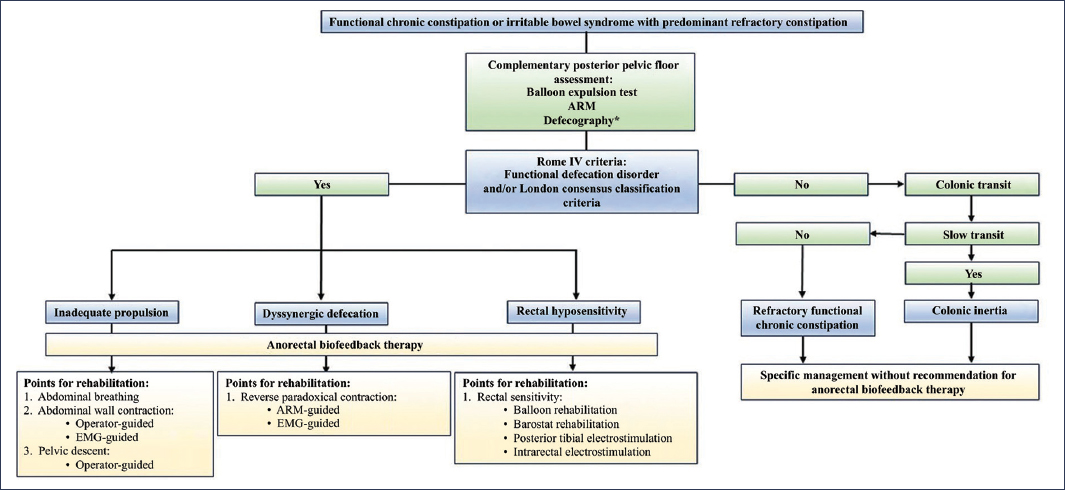
Figure 1. Protocol for the management of chronic constipation and recommendations for anorectal biofeedback therapy. EMG: electromyography; ARM: anorectal manometry.
Another less common indication for ABT is the diagnosis of levator ani syndrome, which is established according to Rome IV criteria. Its diagnosis requires that all of the following criteria be simultaneously fulfilled: presence of chronic or recurrent rectal pain or discomfort; episodes lasting 30 minutes or more; tenderness or pain upon traction of the puborectalis muscle during examination; and exclusion of other causes of rectal pain, such as inflammatory bowel disease, intramuscular abscess, anal fissure, thrombosed hemorrhoids, prostatitis, coccygodynia, and major structural abnormalities of the pelvic floor. The indication for ABT in this context is limited exclusively to those cases in which a pattern of dyssynergic defecation or inadequate propulsion is identified on the ARM or electromyography tracing.4,6,22
Rectal hyposensitivity is another indication for ABT, but the approach differs from the classic protocol of contractile reinforcement and coordination. In this case, the therapeutic goal is sensory rehabilitation, which is achieved using intermittent insufflation of an intrarectal balloon, with or without associated posterior tibial or intrarectal electrostimulation.4,6,11
ABT has an excellent safety profile, and contraindications are related to a patient profile unable to follow instructions due to cognitive or visual deficits, or with underlying pathology that precludes a therapeutic response, such as severe structural or neurological pathology.4,6
Therapeutic goals and predictors of response to anorectal biofeedback therapy
The therapeutic goals of ABT include correcting dyssynergia or incoordination of the abdominal, rectal, and puborectalis muscles and the anal sphincter, with the aim of achieving normal and complete evacuation; facilitating evacuation through simulated defecation training with the balloon expulsion test; and improving rectal sensory perception in patients with impaired rectal sensitivity.6
The effectiveness of ABT in functional defecation disorders ranges from 60% to 80%, with a lower response rate in the inadequate propulsion subgroup. In the case of ABT aimed at sensory rehabilitation in patients with rectal hyposensitivity, the therapeutic response has been reported between 56% and 81%.12–14
Among the main predictors of an adequate therapeutic response to ABT are harder stool consistency, longer time on the balloon expulsion test, higher mean anal resting pressure, higher anal pressure during maximum voluntary contractility, preservation of the rectoanal inhibitory reflex, and adequate patient acceptance and compliance with the procedure6,23 (Table 2).
Table 2. Predictors of response to anorectal biofeedback therapy
| Predictors of adequate response |
|---|
| Bristol 1-2 |
| Longer expulsion time on the balloon expulsion test |
| Higher mean anal resting pressure |
| Higher anal pressure during maximum voluntary contractility |
| Paradoxical contraction |
| Adequate patient acceptance and compliance with the procedure |
| Predictors of inadequate response |
| Rectoanal areflexia |
| Poor propulsion |
| Structural pelvic floor pathology |
| Cortical apraxia |
New therapeutic options in chronic constipation
Traditionally, ABT has been performed in specialized medical units under the supervision of trained healthcare personnel. However, the limited availability of centers, the associated costs, and access difficulties represent significant barriers for many patients. To overcome these limitations, portable devices have been developed that allow self-administered home-based ABT.
In a randomized clinical trial conducted by Rao et al.,8 office-based ABT was compared with home-based ABT in 100 patients with CC and dyssynergic defecation. The home group used a self-inserted probe connected via Bluetooth to a mobile device, allowing the patient to view real-time biofeedback and the physician to monitor progress remotely. The results demonstrated the non-inferiority of home-based ABT compared with office-based ABT, with response rates of 68% and 70%, respectively. Furthermore, home-based ABT was significantly more cost-effective (median cost of $1,082 USD vs. $1,943 USD) and without relevant adverse events.8
Bilateral transcutaneous posterior tibial nerve electrostimulation represents another therapeutic alternative for patients with rectal evacuation disorders refractory to conservative treatment. Madbouly et al.24 evaluated this technique in 36 patients with evacuation disorder without anatomical obstruction, applying 30-minute sessions three times per week for 6 weeks. 47% of patients showed significant clinical improvement, with an average reduction of 10 points in the modified obstructed defecation score, as well as improvements in quality of life and rectal sensitivity thresholds.24
Zhang et al.25 evaluated transcutaneous neuromodulation of the posterior tibial nerve in 12 patients with CC using a crossover design with active and sham stimulation. The intervention significantly increased the frequency of spontaneous bowel movements (83% of patients achieved more than three bowel movements per week), improved symptom scores (PAC-SYM) and quality of life scores (PAC-QOL), and reduced rectal sensitivity volumes. Physiologically, an increase in vagal activity and a reduction in sympathetic activity were observed, changes that were absent with sham stimulation.25
The oral vibrating capsule represents one of the most recent innovations in the treatment of CC. It is an ingestible, programmable device that, following a pre-established delay of 6-8 hours, initiates cyclic mechanical vibrations in the colon. Its mechanism of action consists of direct physical stimulation of the colonic wall, inducing local reflexes and activation of parasympathetic pathways that promote intestinal motility and evacuation, without altering stool consistency.26
In a phase 3 clinical trial conducted by Rao et al.,26 312 patients with CC were randomized to receive a vibrating capsule or placebo, once daily, 5 days per week for 8 weeks. A significantly greater proportion of patients treated with the vibrating capsule achieved the primary response endpoints: 39.3% vs. 22.1% for ≥ 1 complete spontaneous bowel movement per week and 22.7% vs. 11.4% for ≥ 2 complete spontaneous bowel movements per week. Significant improvements were also observed in defecatory straining, stool consistency, and quality of life. Adverse events were mild and similar between groups; only 11% of patients reported a mild vibratory sensation, with no study withdrawals. A post hoc analysis in patients with severe constipation confirmed the efficacy and safety of the vibrating capsule in this subgroup.26
Conclusions
The treatment of constipation is an art, in which we must take into account both the physical, emotional, and intellectual state of the patient and the anatomy, physiology, and pathophysiology in order to design a therapy tailored to each individual, with an ever-growing array of techniques and tools available to help improve this condition and quality of life.
ABT is consolidating its role as a treatment of choice for patients with DD. In well-selected cases, it has an effectiveness rate of up to 80%, as it allows for a comprehensive, targeted, individualized approach based on motor and sensory retraining of the pelvic floor.
Funding
The authors declare that they received no funding for this study.
Conflicts of interest
The authors declare no conflicts of interest.
Ethical considerations
Protection of persons and animals. The authors declare that no experiments were performed on humans or animals for this investigation.
Confidentiality, informed consent, and ethical approval. The study does not involve personal data, clinical records, or human biological samples, and therefore does not require ethical approval. The SAGER guidelines do not apply.
Declaration on the use of artificial intelligence. The authors declare that no type of generative artificial intelligence was used for the writing or creation of content in this manuscript.
