
Introduction
Disorders of gut-brain interaction (DGBI) have a high prevalence in the general population, as they affect any group regardless of sex, race, age, or socioeconomic status. They entail a significant impact on the quality of life of those who suffer from them and have a negative economic impact on the health care system.
According to the Rome IV criteria,1 intestinal DGBIs include the categories detailed in table 1. Each category has specific clinical criteria, although it should be considered that DGBIs constitute a clinical spectrum and may overlap with one another.
Table 1. Rome IV classification of functional bowel disorders1
| C1: Irritable bowel syndrome (IBS) | C2: Functional constipation |
| IBS with predominant constipation (IBS-C) | C3: Functional diarrhea |
| IBS with predominant diarrhea (IBS-D) | C4: Functional abdominal bloating |
| IBS with mixed bowel habits (IBS-M) | C5: Unspecified functional bowel disorder |
| Unclassifiable IBS | C6: Opioid-induced constipation |
Definition of chronic constipation
The term “chronic constipation” (CC) describes the patient’s perception of alterations in bowel movement that may include decreased frequency of bowel movements, hard stools (Bristol scale 1-2) (Fig. 1), difficult evacuation, or a feeling of incomplete evacuation.
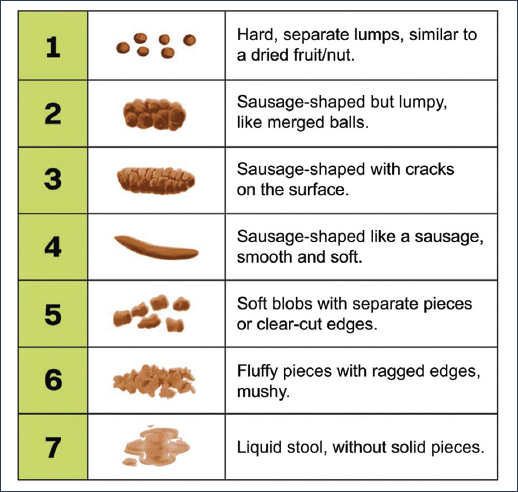
Figure 1. Bristol stool scale.
Constipation is diagnosed when symptoms have a minimum duration of 3 months.2
The definition of constipation may vary among different patients or different healthcare professionals. The most commonly used symptoms in adults to describe it are straining during defecation (52%), hard stools (44%), and absence of frequent bowel movements (34%). The most widely used definition by professionals is the presence of fewer than three bowel movements per week.2
According to its pathophysiology, constipation can be defined as primary or functional, and secondary.
Functional constipation (FC) is defined using the Rome IV clinical criteria, after ruling out mechanical pathologies, medication use, metabolic or endocrine diseases, and neurological causes3 (Table 2).
Table 2. Causes of secondary constipation2
| Mechanical obstruction | Colorectal cancer, diverticulitis, stenosis, rectocele, megacolon, adhesions, fecal impaction |
| Neurological causes | Autonomic neuropathy, stroke, dementia, depression, multiple sclerosis, Parkinson’s disease, spinal cord injury |
| Metabolic causes | Chronic renal failure, type 2 diabetes mellitus, multiple endocrine neoplasia type 2, hypercalcemia, hyperparathyroidism, hypokalemia, hypothyroidism, porphyria |
| Myopathies | Amyloidosis, dermatomyositis, scleroderma, systemic sclerosis |
| Diet-related | Diet high in protein and fat, dehydration, anorexia, excessive consumption of caffeine and alcohol |
| Miscellaneous | Heart failure, immobility |
| Other | Pregnancy, pelvic floor dysfunction |
| Medications | Tricyclic antidepressants, antiepileptics, antihistamines, medications for Parkinson’s disease, antipsychotics, antispasmodics, calcium channel blockers, beta-blockers, monoamine oxidase inhibitors, opioids, antacids, calcium and iron supplements, oral contraceptives, non-steroidal anti-inflammatory drugs, loperamide |
The Rome IV diagnostic criteria are presented in table 3. Compared with previous criteria, the latest version specifies that abdominal pain and bloating may be present but must not be the predominant symptoms, in order to rule out irritable bowel syndrome with constipation (IBS-C). Correct differentiation between these two clinical conditions is important, as many professionals may use the term “functional constipation” interchangeably to encompass both.
Table 3. Rome IV diagnostic criteria for functional constipation3
| C2: Diagnostic criteria for functional constipation |
|---|
| Must include two or more of the following: |
| Straining during more than 25% of bowel movements |
| Hard stools (Bristol scale 1-2) in more than 25% of bowel movements |
| Sensation of incomplete evacuation in more than 25% of bowel movements |
| Sensation of anorectal obstruction or blockage in more than 25% of bowel movements |
| Use of manual maneuvers to facilitate evacuation in more than 25% of bowel movements |
| Fewer than three spontaneous bowel movements per week |
| Loose stools rarely present without laxative use |
| Insufficient criteria for irritable bowel syndrome |
|
Criteria must be fulfilled for 3 months, with symptom onset 6 months prior to diagnosis. |
Clinical studies have demonstrated that 90% of patients with IBS-C meet criteria for functional constipation and 44% of patients with FC meet criteria for IBS-C.4
CC is a multifactorial condition with a complex pathogenesis, in which both modifiable and non-modifiable risk factors exist. Modifiable risk factors include a sedentary lifestyle, low fluid intake, low fiber intake, and poor sleep quality. Non-modifiable risk factors include female sex, advanced age, and low socioeconomic status. Secondary causes include medications such as opioids, benzodiazepines, antidepressants, and antispasmodics, as well as diseases such as type 2 diabetes mellitus, chronic renal failure, chronic obstructive pulmonary disease, and ischemic heart disease, among others (Table 2).5
Epidemiology of chronic constipation
CC is highly prevalent among adults in the global population,6 with an estimated global prevalence of 14%. In older adults, the prevalence increases to approximately 32%. In Africa and Asia, the prevalence is lower (13%).6
According to the Rome IV epidemiological criteria,3 there are significant differences in the prevalence of FC across geographical areas, with an estimated prevalence of 11.7%. Prevalence is higher (approximately double) in women than in men,7 and a lower frequency has been observed in obese European patients,8 which contrasts with the evidence that the presence of FC is correlated with body mass index.9 In hospitalized patients, the prevalence is 50%.10
CC is commonly self-diagnosed by patients, and based on patient-defined criteria, the prevalence ranges from 1.9% to 27.2%. Only 20% of patients with CC seek medical attention, considering their bowel habits as normal,11 which leads to underdiagnosis of the disease.
In an epidemiological study conducted in the United Kingdom between 2017 and 2018, approximately 200 patients were hospitalized due to complications of constipation, leading to a total of 160,000 bed-days per year.12
The female-to-male ratio is 1.5:1, and women use laxatives more frequently and seek medical attention more often.4
In Mexico, the prevalence of CC ranges from 2.4% to 22.3%;13 a meta-analysis of studies conducted in the Mexican population showed a prevalence of 14.4%, very similar to that recorded worldwide.14,15
Regarding the impact on the health care system, the aforementioned United Kingdom study showed that annual expenditure for the treatment of CC exceeded 160 million pounds, including more than 70 million for hospitalizations and 90 million for laxative use.16
CC ranks fifth among the most frequent gastrointestinal clinical diagnoses, with approximately 8 million outpatient visits per year, 33% in primary care, 21% in pediatrics, and 14% in gastroenterology. The number of these visits surpasses that of patients with colon cancer.
Direct medical costs in the United States have been estimated at 230,000 dollars annually, twice as high in women with constipation as in those without it.4 In Mexico, no studies on this matter are available.
In patients with FC, general health, mental health, and social life are worse. Quality of life scores in patients hospitalized for CC are comparable to those of patients with Crohn’s disease, and in outpatients they are comparable to those of patients with gastroesophageal reflux disease, arterial hypertension, diabetes, or depression.4
In the study conducted by Ruiz López et al.17 in patients with IBS-C and FC, using the PAC-QOL and SF-36 quality of life scales, it was demonstrated that the quality of life of Mexican patients with constipation symptoms is lower, especially in those with IBS-C.
Subtypes of chronic constipation
From a clinical perspective, constipation can be classified as secondary when it is due to mechanical, metabolic, or neurological alterations, or to medication use (Table 2), and as primary or functional when these causes have been ruled out.
FC is classified, according to colonic transit studies, as normal transit constipation (NTC) (60-70%), slow transit constipation (STC) (15-30%), and disorders of the defecation mechanism (20-30%).6
STC is defined as the presence of slow colonic transit in the absence of disorders of the defecation mechanism or megacolon. It may be a manifestation of colonic motor dysfunction or secondary to poor caloric intake. However, only a small percentage of patients exhibit motor dysfunction when evaluated with manometry. Manometric abnormalities include reduced high-amplitude contractions and reduced retrograde propagated and non-propagated activity of the sigmoid colon, as well as phasic activity of the rectum. The response to a meal or the pharmacological test with bisacodyl are equally impaired. Colonic inertia is defined as an absence of response to meals or pharmacological stimuli such as bisacodyl or neostigmine.
A significant reduction in intrinsic nerves and interstitial cells of Cajal has been described.
In STC, an alteration in colonic transit is evidenced on complementary tests, while pelvic function is normal.4,5
NTC is characterized by the absence of pathological findings on history-taking and physical examination, and may present with pain and bloating (if it meets criteria for IBS-C); however, it is not synonymous with IBS-C, as 23% of these patients exhibit slow colonic transit.4,5
Disorders of the defecation mechanism are characterized by prolonged or excessive straining, difficulty with defecation even of soft stools, and use of manual maneuvers to facilitate defecation. Abnormalities are found on anorectal function tests, and it may coexist with normal or slow transit. Among the abnormalities described on anorectal function tests are elevated resting anal pressure, incomplete anal relaxation, or paradoxical contraction of the puborectalis muscle and the external anal sphincter (defecatory dyssynergia).
The relationship between these abnormalities and defecatory symptoms is unclear, as it has been found that asymptomatic patients may exhibit dyssynergic defecation.
The etiology is poorly understood, but it may be secondary to ignoring the urge to defecate or to an abnormal anal response to prevent pain or trauma. In some patients, alterations in rectal sensitivity may be diagnosed that can explain the absence of the urge to defecate.4,5
Opioid-induced constipation encompasses a spectrum of disorders that present as gastrointestinal side effects of the use of these medications. The Rome Committee decided not to include it as a new DGBI, but rather to classify it as an opioid-induced side effect.1 According to the Rome IV criteria, it is defined as a change in baseline bowel habits following the initiation of opioid treatment, including decreased frequency of bowel movements, a sensation of incomplete evacuation, the presence or increase of straining during defecation, and the patient’s perception of problems related to their bowel habits (Table 4). The prevalence of opioid-induced CC is 41% in non-oncological patients treated with opioids, and in oncological patients, the incidence reaches 94%.18 Prevalence increases with prolonged treatment.18
Table 4. Rome IV diagnostic criteria for the diagnosis of opioid-induced constipation
| New-onset constipation or worsening of pre-existing constipation following initiation or dose increase of opioids |
| Presence of two or more of the following criteria: |
| Loose stools rarely present without laxative use |
| Fewer than three bowel movements per week |
| Hard stools (Bristol scale 1-2) in more than 25% of bowel movements |
| Straining in more than 25% of bowel movements |
| Sensation of incomplete evacuation in more than 25% of bowel movements |
| Sensation of anal blockage in more than 25% of bowel movements |
|
Manual maneuvers to facilitate evacuation in more than 25% of bowel movements. |
Conclusion
CC is a highly prevalent condition that constitutes one of the leading causes of medical consultation both in primary care and in gastroenterology, and has a significant impact on the quality of life of those who suffer from it.
It may be secondary to multiple factors that must be ruled out as a priority. FC should be diagnosed according to the Rome IV criteria with the aim of making a positive diagnosis and avoiding excessive use of diagnostic tests, as this has a negative economic impact on the health care system.
Opioid-induced constipation must be considered a separate condition whose management and treatment are specific and which impacts the quality of life of patients under chronic treatment with these medications.
Funding
The author declares that no funding was received for this study.
Conflicts of interest
The author declares no conflicts of interest.
Ethical considerations
Protection of persons and animals. The author declares that no experiments were conducted on human beings or animals for this research.
Confidentiality, informed consent, and ethical approval. The study does not involve personal data, clinical records, or human biological samples; therefore, ethical approval is not required. The SAGER guidelines do not apply.
Declaration on the use of artificial intelligence. The author declares that no generative artificial intelligence was used in the writing or creation of the content of this manuscript.
