
Introduction
Constipation is a highly prevalent gastrointestinal disorder affecting populations of all ages, with greater frequency among women and older adults.1,2 It is associated with a negative impact on quality of life, work productivity, and psychological well-being, in addition to generating a considerable burden on healthcare systems.3 Despite its frequency, constipation represents a clinically heterogeneous condition, with multiple underlying mechanisms that cannot be explained solely by bowel movement frequency or stool consistency.4
Historically, the approach to constipation has focused on a symptomatic and descriptive perspective, based on clinical criteria and response to empirical treatment. While this approach is useful for clinical classification, it is insufficient to understand the diversity of presentations and variability in therapeutic response.4,5 Evidence accumulated over recent decades has demonstrated that constipation may originate from alterations in colonic motility, disorders of anorectal coordination, sensory disturbances, or combinations of these mechanisms.6–8
The colon plays a central role in the pathophysiology of constipation by acting as a dynamic organ responsible for the storage, propulsion, and sensory modulation of luminal contents.9,10 These functions depend on a specific anatomical organization and a complex interaction among smooth muscle, the enteric nervous system, the interstitial cells of Cajal, and sensory perception mechanisms.11–14 Disruption of any of these components can result in abnormal motor patterns, changes in colonic transit, and alterations in the perception of the urge to defecate.6–8,15
The aim of this article is to integrate current knowledge on the anatomy and physiology of the colon, in accordance with recent scientific evidence, in order to provide a pathophysiological framework that enables a better understanding of constipation and its distinct clinical phenotypes.4–8
Macroscopic anatomy of the colon
The colon is a specialized tubular organ that extends from the ileocecal valve to the rectosigmoid junction, with an approximate length of 120 to 150 cm.9,16 Its anatomical organization into segments (cecum, ascending, transverse, descending, and sigmoid colon) not only follows topographic criteria but also reflects a functionally relevant differentiation for intestinal transit and evacuation.9,10,16 Each segment presents distinct mechanical, motor, and sensory properties that govern the behavior of luminal contents.9,10
The proximal colon plays a predominant role in the absorption of water and electrolytes, as well as in the bacterial fermentation of non-digestible carbohydrates.9,10 This function contributes to the progressive solidification of fecal content and is closely related to mixing and segmentation motor patterns.17,18 In contrast, the distal colon acts primarily as a reservoir, regulating the storage and release of contents toward the rectum.9,10 This specialization explains why transit disturbances may manifest regionally, with fecal retention predominating in certain segments.6,10
The hepatic and splenic flexures are anatomical transition zones that involve changes in the orientation of the colon and in its fixation to the retroperitoneum.16 These regions may influence the propagation of motor waves and the distribution of intraluminal pressures.17,18 Likewise, the greater mobility of the transverse and sigmoid colon, compared with the relative fixation of the ascending and descending colon, leads to biomechanical differences that may favor content retention in situations of ineffective motility.9,16 From a pathophysiological standpoint, these anatomical characteristics contribute to interindividual variability in colonic transit and to susceptibility to constipation.6,10
Architecture of the colonic wall
The colonic wall presents a complex histological organization designed to support highly coordinated motor, secretory, and sensory functions.11,12 The muscularis propria, composed of a continuous inner circular layer and a discontinuous outer longitudinal layer organized into teniae, is responsible for generating the various colonic contraction patterns.11,17 This particular arrangement permits both the formation of haustra, associated with segmental motility, and the propagation of peristaltic waves of greater amplitude.17,18
The enteric nervous system, composed of the myenteric and submucosal plexuses, plays a primary role in the regulation of colonic activity.11,12 The myenteric plexus is the principal modulator of motility, while the submucosal plexus participates in the regulation of secretion and blood flow.11,12 Both plexuses function autonomously yet are integrated with signals from the central nervous system via sympathetic and parasympathetic pathways.12 This autonomy explains why localized alterations of the colonic wall may generate motor dysfunction even in the absence of evident structural lesions.11,12
The interstitial cells of Cajal act as electrical pacemakers and as intermediaries in signal transmission between enteric neurons and smooth muscle.13,14 Their distribution throughout the colon is heterogeneous and segmental, contributing to the diversity of regional motor patterns.13 Histopathological and functional studies have demonstrated that a reduction in the density or an alteration in the function of these cells is associated with colonic transit disorders, particularly in patients with slow-transit constipation, reinforcing their key role in the pathophysiology of constipation.14,19
Motor physiology of the colon
Colonic motility results from the interaction of myogenic, neural, and humoral mechanisms and is expressed through specific motor patterns with distinct functions.17,18 Segmental motility, characterized by localized non-propagated contractions, facilitates mixing of luminal contents and prolongs contact time with the mucosa, promoting absorption.17 This pattern predominates in the proximal and distal colon under basal conditions.17,18
High-amplitude propagated contractions are the principal propulsive mechanism of the colon.18,20 These motor events, low in frequency but high in efficacy, allow the displacement of fecal content along extensive colonic segments and are fundamental for rectal filling and initiation of the defecatory reflex.18,20 A reduction in the frequency, amplitude, or propagation of these contractions has been consistently reported in patients with slow-transit constipation.6,19,21
Colonic motor activity also exhibits marked circadian variability, with significant increases upon awakening and following meals.18,20 This behavior reflects the influence of the central nervous system, the autonomic nervous system, and hormonal mediators.20 Disruption of these physiological rhythms, whether through neuromuscular dysfunction, aging, or changes in lifestyle habits, may contribute to the development or perpetuation of chronic constipation.3,6
Sensory physiology of the colon
The colon not only fulfills motor functions but also acts as a sophisticated sensory organ capable of detecting changes in intraluminal volume and pressure. Mechanoreceptors present in the colonic wall respond to distension and transmit afferent signals via visceral pathways to the central nervous system, enabling the perception of transit and fecal contents.
Colonic visceral sensitivity is governed by sensory thresholds that vary among individuals and may be modified under pathological conditions.22 In constipation, phenomena of colonic and rectal hyposensitivity have been described, characterized by a decrease in the perception of filling, which promotes prolonged retention of contents and loss of the urge to defecate.7,15 In other contexts, particularly when functional disorders coexist, visceral hypersensitivity may be observed, with an exaggerated perception of physiological stimuli.22
The disruption of integration between the afferent signal and the motor response constitutes a key mechanism in the pathophysiology of constipation. The dissociation between objective distension and subjective perception may give rise to ineffective motor patterns, regardless of the structural integrity of the colon, underscoring the importance of considering sensory mechanisms in the evaluation of patients with chronic constipation.7,22
Functional colon-rectum integration
Effective bowel evacuation depends on precise coordination among the colon, the rectum, and the anal canal.8,23 Colonic transit culminates in rectal filling, an event that triggers a cascade of neuromuscular reflexes oriented toward defecation.23 This functional integration represents a critical point in the pathophysiology of constipation.8,23
Rectal distension activates reflex mechanisms that modulate the tone of the internal anal sphincter and facilitate discrimination of rectal contents, enabling voluntary decision-making regarding evacuation.23 Alterations in this coordination can generate a disconnection between colonic transit and the effective expulsion of contents, even in the presence of relatively preserved colonic motility.8,23
From a clinical perspective, the lack of colon-rectum synchrony explains the frequent coexistence of multiple constipation mechanisms in a single patient, such as slow colonic transit associated with defecatory disorders.6,8 This pathophysiological complexity highlights the need for a comprehensive evaluation that considers both colonic and anorectal function for an adequate characterization of constipation.6,8,23
Discussion
The available anatomical and physiological evidence demonstrates that constipation is not a uniform condition, but rather the clinical expression of heterogeneous alterations affecting different levels of colonic function and its integration with the rectum. Understanding the colon as a dynamic organ with highly specialized motor and sensory functions allows for an explanation of the broad clinical variability observed in patients with constipation and the differences in response to conventional therapeutic strategies.4–8 From an anatomical standpoint, the functional segmentation of the colon and its regional biomechanical characteristics determine differentiated patterns of transit and storage. The predominance of absorption and mixing functions in the proximal colon, together with the reservoir role of the distal colon, explains why regional alterations may translate into specific constipation phenotypes. Likewise, the arrangement of the flexures and the degree of colonic fixation influence the propagation of motor waves, which becomes relevant in the context of motility disorders.
Regarding the architecture of the colonic wall, the interaction among smooth muscle, the enteric nervous system, and the interstitial cells of Cajal emerges as a central axis in the regulation of motility. Evidence linking dysfunction of these components with slow-transit constipation supports the notion that, in a subgroup of patients, the disorder has a neuromuscular rather than a purely functional basis. This concept is key to interpreting physiological studies and to avoiding uniform therapeutic approaches in a clearly heterogeneous population.
The motor physiology of the colon, characterized by the coexistence of segmental and propulsive patterns, allows for an understanding of how alterations in the frequency, amplitude, or synchronization of high-amplitude propagated contractions may result in slow colonic transit. The loss of normal circadian rhythms and of the postprandial response reinforces the importance of neurohumoral integration mechanisms in the genesis of chronic constipation, particularly in patients with predisposing factors such as aging or autonomic dysfunction.
Furthermore, colonic sensory mechanisms play a fundamental role in the regulation of transit and the defecatory reflex. The presence of hyposensitivity contributes to prolonged retention of fecal contents and to a diminished urge to defecate, while alterations in sensorimotor integration may generate a disconnection between objective distension and an adequate motor response. These findings underscore that constipation cannot be explained solely by motor alterations but requires a comprehensive consideration of the sensory components.
Finally, the functional integration between the colon and the rectum represents a critical point in the pathophysiology of constipation. The lack of synchrony between colonic transit and effective evacuation explains the frequent coexistence of diverse mechanisms in a single patient. This pathophysiological complexity has relevant diagnostic implications and supports the need for a functional evaluation that considers both colonic and anorectal function.
Figure 1 schematically summarizes the principal anatomical and physiological mechanisms involved in the pathophysiology of constipation and their correlation with the various clinical phenotypes.
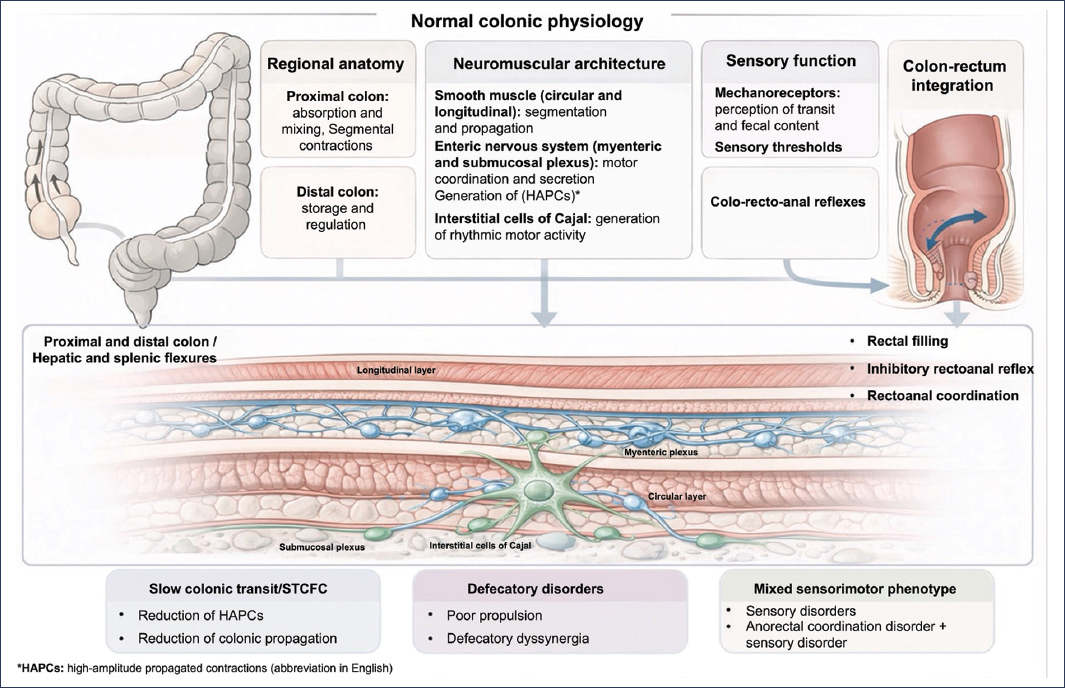
Figure 1. Anatomical and physiological mechanisms involved in the pathophysiology of constipation.
Conclusions
Constipation should be understood as the clinical manifestation of an anatomical-functional dysfunction of the colon and its integration with the rectum, rather than as a disorder defined exclusively by bowel movement frequency or stool consistency. Colonic anatomy, the architecture of its wall, the intrinsic neuromuscular systems, and the visceral sensory mechanisms interact in a complex manner to regulate transit and evacuation.
Current evidence supports the concept that alterations at any of these levels may give rise to distinct constipation phenotypes, which explains the clinical heterogeneity observed in daily practice. Understanding the colon as a dynamic and functional organ allows for a more precise interpretation of symptoms and findings in physiological studies and facilitates the identification of the predominant mechanisms in each patient.
Anatomical and physiological knowledge of the colon constitutes a fundamental pillar for approaching constipation from a pathophysiological perspective. This approach, in addition to enhancing understanding of the disorder, provides the foundation for more rational and individualized diagnostic and therapeutic strategies. Future functional and physiological studies are needed to deepen our understanding of the underlying mechanisms and to optimize the classification and management of constipation in clinical practice.
Funding
The author declares that no funding was received for this study.
Conflicts of interest
The author declares no conflicts of interest.
Ethical considerations
Protection of human and animal subjects. The author declares that no experiments involving human beings or animals were performed for this research.
Confidentiality, informed consent, and ethical approval. The study does not involve personal data, medical records, or human biological samples; therefore, ethical approval is not required. The SAGER guidelines do not apply.
Declaration on the use of artificial intelligence. The author declares that no form of generative artificial intelligence was used in the writing or content creation of this manuscript.
