
Introduction
Peptic ulcer disease (PUD) is a condition characterized by lesions in the gastric and duodenal mucosa, caused by an imbalance between acid secretion, pepsin, and the defense mechanisms of the mucosa. Its etiology is multifactorial, but there are some determining factors, such as Helicobacter pylori infection, the use of nonsteroidal anti-inflammatory drugs (NSAIDs), physiological stress, and diet. Specifically, H. pylori infection and NSAIDs trigger complications such as ulcer formation.1–3
Although diet has been considered a factor associated with the etiology, evolution, and symptoms of the disease, scientific evidence is scarce and not conclusive. Nevertheless, patients report symptom improvement with highly restrictive regimens, and recent studies show that certain specific dietary patterns influence the risk of developing PUD, symptom intensity, or treatment response. Although diet does not constitute a primary etiological factor, the intake of certain foods could modulate the manifestation of the disease and significantly affect the patient’s quality of life2–4 (Fig. 1). Therefore, the objective of this review was to evaluate the hygienic-dietary factors with the highest level of evidence related to PUD symptoms.
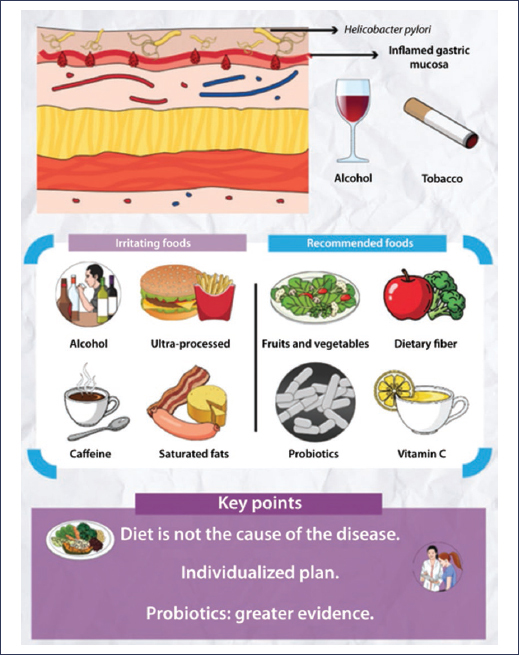
Figure 1. Graphic summary.
Method
A narrative literature review was conducted in PubMed, limited to publications between January 2015 and December 2025. Observational studies, clinical trials, meta-analyses, and systematic reviews that evaluated the relationship between diet, nutrition, and PUD symptoms were included. The level of evidence was classified according to the GRADE scale (Grading of Recommendations Assessment, Development, and Evaluation),5 and values were considered significant with p < 0.05.
Results and discussion
In patients with PUD, diet could worsen symptoms after the intake of certain foods; however, current scientific evidence suggests that many of these foods do not participate directly in the etiopathogenesis of the disease, although they can modulate symptom intensity and perception of discomfort. Empirically, foods such as alcohol, chili peppers, and various seasonings have been classified as symptom triggers (irritating foods) or as protective factors6 (Table 1).
Table 1. Foods associated with symptoms of acid-peptic disease according to the GRADE classification
| Food | Clinical effect reported | Level of evidence |
|---|---|---|
| Alcohol | Direct gastric mucosal injury, increased inflammation and dyspeptic symptoms; association with poorer clinical course | Moderate |
| Coffee/caffeine | Increased dyspeptic symptoms; variable effect on acid secretion | Low |
| Ultra-processed foods | Higher risk of developing peptic ulcer and chronic gastritis | Moderate |
| Foods rich in saturated fats/fried foods | Delayed gastric emptying and worsening of symptoms | Low |
| Spicy foods (chili peppers, capsaicin) | Do not worsen healing, but may cause symptoms in sensitive patients | Moderate |
Foods associated with PUD symptoms
ALCOHOL
Alcohol consumption is consistently associated with direct damage to the gastric mucosa, increased epithelial permeability, and local inflammation. Observational studies have demonstrated a significant association between high alcohol consumption and a higher prevalence of peptic ulcer, as well as poorer symptom control7; however, epidemiological studies and meta-analyses show an inverse association between moderate alcohol consumption and the presence of H. pylori, suggesting that those who consume alcohol have lower seroprevalence or active infection than non-drinkers.8 This inverse relationship appears to be stronger with certain types of beverages, such as wine and cocktails, and in people over 40 years of age.8 On the other hand, in a meta-analysis evaluating the dose-response effect, moderate alcohol consumption (10-30 g/day) was found to be associated with a lower risk of infection, but the effect diminishes and is less consistent with higher consumption.9 Regarding dietary factors, the quality of available evidence is heterogeneous. Alcohol consumption has moderate-level evidence, derived mainly from observational studies and some clinical trials, demonstrating direct gastric mucosal injury, increased inflammation, and exacerbation of dyspeptic symptoms, as well as its association with a less favorable clinical course.
COFFEE AND CAFFEINE
Coffee is one of the most consumed beverages in the world. It contains multiple bioactive compounds, including caffeine, polyphenols (mainly chlorogenic acids), and diterpenes such as cafestol and kahweol, with antioxidant, anti-inflammatory, antifibrotic, and microbiome-modulating effects.10
Regarding PUD symptoms, studies have not demonstrated a significant association between coffee consumption and the development of gastric ulcer, duodenal ulcer, or PUD, which questions its classification as a non-recommended food.10,11 On the other hand, although recent evidence does not demonstrate a direct relationship between coffee and PUD symptoms, it stimulates gastric acid secretion and some studies report exacerbation of symptoms, possibly associated with sugar in the preparation, so its restriction is recommended empirically and in an individualized manner.12,13 The effect of coffee and caffeine is supported by low-level evidence, with inconsistent results regarding its impact on acid secretion and exacerbation of dyspeptic symptoms, without conclusive demonstration of sustained structural damage.
ULTRA-PROCESSED FOODS
The term “ultra-processed foods” (UPF) refers to industrialized products with multiple ingredients and additives, typically high in calories, saturated fats, sugar, and salt, and low in fiber, micronutrients, and bioactive compounds. This type of diet has been associated with various metabolic and inflammatory damage. Some recent studies have explored whether UPF consumption is associated with a higher incidence of H. pylori infection and with PUD symptoms.14,15 In a case-control study conducted by Ebrahimi et al.14 in 2024, it was reported that individuals in the highest quartile of UPF consumption presented a significant increase in the probability of H. pylori infection (adjusted odds ratio approximately 1.5-2.0, depending on the statistical model), even after adjusting for body mass index, age, sex, energy consumption, physical activity, and smoking. Consistently, in the prospective cohort of the SUN project,15 higher UPF consumption was associated with an increased risk of peptic ulcer disease, with a relative risk close to 1.3-1.5 at the highest intake levels compared to the lowest.
UPF are foods that present moderate evidence suggesting an association with higher risk of peptic ulcer and chronic gastritis, although most data come from epidemiological studies, which limits direct causal inference. Similarly, foods rich in saturated fats or fried foods present in UPF show low evidence, mainly based on physiological studies and clinical reports, suggesting delayed gastric emptying and possible symptomatic worsening, without robust evidence of mucosal lesion progression.
Chili peppers and capsaicin
Chili pepper is a common ingredient in the diet of numerous cultures, especially in Mexico. Its main active compound is capsaicin, which acts on the vanilloid type 1 receptor, involved in the perception of painful, thermal, and mechanical stimuli. Acute exposure to capsaicin can induce symptoms such as retrosternal burning, abdominal pain, nausea, and sensation of heat; however, repeated exposure destabilizes the receptor and improves tolerance. It has not been shown to affect gastric mucosal healing, which justifies a recommendation based on individual tolerance.16
On the other hand, in addition to its sensory effects, capsaicin possesses multiple potentially beneficial properties. As systemic effects, it is attributed antioxidant, anti-inflammatory, lipid-lowering, anti-obesity, and cardioprotective properties. In the digestive tract, a gastroprotective effect, increased mucosal blood flow, regulation of visceral nociception, and improved micronutrient absorption have been described. Clinical studies have shown that, in patients with functional dyspepsia and irritable bowel syndrome, regular chili pepper consumption decreases symptoms and increases the threshold of visceral sensitivity.17,18
Currently, there is insufficient evidence to recommend capsaicin as therapy; however, it is suggested not to restrict its consumption in patients with stable H. pylori, except in cases of individual intolerance.5 Spicy foods, including chili peppers and capsaicin, have moderate evidence indicating that they do not interfere with mucosal healing; however, they can induce symptoms in patients with visceral hypersensitivity, which suggests a predominantly functional rather than structural effect.
Foods associated with improvement of PUD symptoms
In patients with PUD, international guidelines have recommended easily digestible foods, low in fat, of soft consistency and with low acid content, such as rice, oatmeal, banana, pear, lean meats, and low-fat dairy products, which can contribute to symptom improvement.
Specifically, lean proteins that are easily digestible contribute to maintaining an adequate nutritional status without excessively stimulating acid secretion, and are well tolerated by most patients. Fruits, vegetables, and dietary fiber have shown, in various observational studies and systematic reviews, that they are associated with a lower risk of PUD due to their anti-inflammatory and microbiome-modulating effects.19 A diet rich in non-acidic fruits and vegetables has moderate evidence suggesting a lower association with gastric inflammation and better digestive tolerance. However, these findings derive mainly from observational studies and some clinical trials with methodological limitations, although they have demonstrated consistency in symptom improvement20 (Table 2). Similarly, adequate intake of dietary fiber presents moderate evidence, being associated with lower risk of peptic ulcer disease and better gastrointestinal function. Most data come from prospective epidemiological studies, with biological plausibility related to modulating effects on the microbiota and inflammation.
Table 2. Recommended foods for symptom improvement of PUD according to the GRADE classification
| Food | Clinical effect reported | Level of evidence (Oxford) |
|---|---|---|
| Fruits and vegetables (non-acidic) | Lower gastric inflammation and better digestive tolerance | Moderate |
| Dietary fiber | Association with lower risk of peptic ulcer and better gastrointestinal function | Moderate |
| Lean proteins (chicken, fish, legumes) | Maintain nutritional status without stimulating excessive acid secretion | Low |
| Probiotics (yogurt, kefir) | Reduction of adverse effects and improvement of H. pylori eradication | High |
| Vitamin C and dietary antioxidants | Possible support in healing and H. pylori control | Moderate |
| Olive oil and unsaturated fats | Better gastric tolerance compared to saturated fats | Low |
PROBIOTICS
Standard treatment in patients with H. pylori infection includes antibiotics and proton pump inhibitors, which usually trigger bacterial resistance and side effects. This has led to investigating whether probiotics could improve therapeutic outcomes.20,21
Scientific evidence from recent meta-analyses indicates that the use of probiotics as adjuvants in the treatment of H. pylori infection improves the eradication rate and decreases the incidence of gastrointestinal adverse effects, such as diarrhea, nausea, and abdominal pain, through mechanisms such as modulation of the gastrointestinal microbiota, production of lactic acid and bacteriocins that inhibit H. pylori growth, and interference with bacterial adhesion to the gastric epithelium and reduction of adverse effects of antibiotic therapy. Most meta-analyses show that probiotics added to standard therapy modestly increase the probability of H. pylori eradication (relative risk: 1.10-1.60) compared to standard therapy alone. However, the results are not significant when compared strictly to placebo, suggesting methodological differences between both. Nevertheless, to date, probiotic consumption is the therapeutic strategy with the highest evidence as an adjuvant to decrease adverse effects and improve tolerability of standard antibiotic treatment, with an additional benefit in the eradication rate of H. pylori22–26 (Table 3), particularly those present in yogurt and kefir, supported by numerous randomized clinical trials and meta-analyses.
Table 3. Probiotics and their relationship with acid-peptic disease symptoms
| Study | Design | Population | Probiotic intervention | Results |
|---|---|---|---|---|
| Tanashat et al.21 | 91 RCTs | n ≈ 13,680 | Probiotics plus standard therapy | Higher eradication (OR: ≈ 1.60), fewer side effects (diarrhea, pain) with multiple strains compared to controls |
| Felley and Michetti22 | Review | Variable | Conceptual | Probiotics can modulate adhesion and inflammation |
| Lu et al.23 | Meta-analysis | 21 RCTs | Probiotics plus standard therapy vs. placebo | No statistically significant improvement was found in some placebo vs. control analyses |
| Penumetcha et al.24 | 11 studies | Variable | Probiotics vs. standard therapy | Probiotics alone are not very effective for eradication by themselves; in combination, there is slight improvement and reduction of effects |
| Yang et al.25 | 28 meta-analyses | 534 combined RCTs | Probiotics plus standard therapy | Higher eradication (RR: 1.10; 95% CI: 1.06-1.14), lower risk of effects (RR: 0.54) |
| Zhang et al.26 | 12 RCTs | 2,144 | Probiotics before therapy | Higher eradication (≈ 80% vs. 70%) and fewer adverse effects |
|
RCTs: randomized controlled trials; 95% CI: 95% confidence interval; OR: odds ratio; RR: relative risk. |
||||
Vitamin C supplementation has also shown potential benefits in reducing H. pylori bacterial load and in mucosal healing, although the evidence is still limited.27 Specifically, vitamin C and other dietary antioxidants show moderate evidence, although limitations persist regarding sample size and heterogeneity of interventions.
Other dietary strategies, such as lean proteins, olive oil, and unsaturated fats, show a favorable physiological profile and adequate gastric tolerance, but the evidence supporting their direct clinical benefit on structural outcomes (inflammation, healing, or prevention of ulcer disease) is limited and is mainly based on observational studies, physiological studies, and expert recommendations. Therefore, their inclusion in the diet can be considered reasonable within a comprehensive nutritional approach, but a specific recommendation based on robust high-level evidence cannot be established with high certainty.
Hygienic-dietary measures in PUD
It has been shown that some foods have a certain relationship with the disease, so it is important to consider avoiding or moderating their consumption to improve symptoms. However, changes must also be made in eating habits that could help regulate acid secretion, decrease symptoms, and improve quality of life. Changes such as having fractional and regular meals, avoiding prolonged fasting, chewing slowly, following a fiber-rich diet, increasing the supply of high biological value proteins, performing physical activity to promote proper protein absorption, and considering the incorporation of probiotics through fermented foods, are general strategies that favor patients’ symptoms and treatment response.4
Scientific evidence confirms that diet and a healthy lifestyle do not replace medical treatment for PUD symptoms, but play an important role in symptom control and secondary prevention. Avoiding universal restrictive recommendations and treating patients’ diet individually, based on tolerance and healthy dietary patterns, could improve symptoms and treatment response.6
Conclusions
Diet can influence the clinical manifestations of PUD symptoms and patients’ quality of life. High consumption of alcohol and UPF is associated with a worse prognosis, while diets rich in fiber, fruits, and vegetables are safe and potentially protective. Foods such as coffee and chili peppers do not have a direct causal role, so their restriction should be individualized according to tolerance. Hygienic-dietary measures complement pharmacological treatment, highlighting probiotics as adjuvants with greater scientific support, especially in the presence of H. pylori. More clinical trials are required to define specific dietary recommendations.
Funding
The author declares that she did not receive funding for this study.
Conflicts of interest
The author declares no conflicts of interest.
Ethical considerations
Protection of people and animals. The author declares that no experiments were performed on humans or animals for this research.
Confidentiality, informed consent, and ethical approval. The study does not involve personal data, medical records, or human biological samples, so it does not require ethical approval. The SAGER guidelines do not apply.
Declaration on the use of artificial intelligence. The author declares that no type of generative artificial intelligence was used for the writing or content creation of this manuscript.
