
Introduction
Chronic constipation is one of the most common gastrointestinal disorders worldwide and constitutes a frequent reason for consultation in outpatient practice, as well as a common indication for referral to gastroenterology and colorectal surgery. Its global prevalence is estimated at approximately 15%, with variations depending on the population studied; it is more frequent in older adults and in women. In the geriatric population, it may reach up to 40% in the community setting and more than 70% in long-term care facilities, reflecting a greater burden of comorbidity and the use of associated medications.1–4
Functional constipation is the most common form of primary constipation and is defined as a syndromic diagnosis based on symptoms, in accordance with the Rome IV criteria, with an approximate prevalence of 10.1%.3–5 From a surgical perspective, it is fundamental to recognize that this is not a homogeneous condition, but rather a spectrum of disorders with distinct pathophysiological mechanisms and variable therapeutic responses; therefore, clinical evaluation alone is insufficient to identify candidates for surgical treatment.1,2
According to its pathophysiology, functional constipation is classified into three main subtypes: normal colonic transit, slow colonic transit, and evacuatory disorders or pelvic floor dyssynergia. This classification has direct implications for therapeutic decision-making, as surgical treatment is not indicated in patients with normal colonic transit or in those with isolated evacuatory disorders, in whom management should be conservative or directed toward pelvic floor rehabilitation.1–3
Within the spectrum of slow colonic transit constipation lies the entity known as colonic inertia, a rare phenotype characterized by severe colonic hypomotility, diffuse delayed transit, and absence of anorectal outlet obstruction, with abnormalities documented in functional studies.5 Although it does not constitute a formal diagnosis in current classification systems, its recognition is relevant in colorectal surgery, as it represents the primary scenario in which colectomy may be considered a therapeutic option in appropriately selected patients who are refractory to medical treatment.1,2,6
Additionally, in patients with chronic constipation, other functional gastrointestinal disorders and alterations in gut-brain interaction may coexist, which influence the clinical presentation and therapeutic response. Likewise, psychological comorbidity, including gastrointestinal-specific anxiety and eating disorders, has been associated with a greater symptom burden and less favorable outcomes following surgical interventions.7,8
Despite constipation being a frequent reason for consultation with the colorectal surgeon, fewer than 5% of patients with functional constipation are candidates for surgical treatment. In this context, the surgical indication must be supported by a comprehensive pathophysiological evaluation and strict clinical and functional criteria.
The objective of this article is to review the role of surgical treatment in functional chronic constipation, with emphasis on refractory slow colonic transit constipation, and to analyze the selection criteria, available surgical options, and their outcomes. Evacuatory disorders are briefly addressed as part of the differential diagnosis in the preoperative evaluation.
Method
A narrative review of the literature was conducted with the objective of analyzing the available evidence on the surgical treatment of chronic constipation, with emphasis on selection criteria and functional outcomes of the various interventions.
The search was performed in the PubMed/MEDLINE, Scopus, and Google Scholar databases, including literature published in English and Spanish, without date restriction, with emphasis on recent and clinically relevant publications. The search terms used were “chronic constipation,” “slow transit constipation,” “surgical treatment,” “subtotal colectomy,” “pelvic floor disorders,” and “constipation surgery,” individually and in combination.
Original articles, narrative reviews, systematic reviews, and clinical practice guidelines considered relevant to the focus of the manuscript were included. Study selection was performed in a targeted manner, prioritizing those with the highest methodological quality, clinical relevance, and consistency with the objective of the review.
Given the narrative nature of the study, the selection and synthesis of information were performed qualitatively, without a systematic formal evaluation process or quantitative data analysis.
Surgical strategies in chronic constipation
The main challenge in the management of refractory chronic constipation lies in distinguishing symptom persistence from true colonic motor disorders amenable to surgical treatment. In clinical practice, symptom severity may lead to surgical referral before a complete physiological characterization has been performed, favoring therapeutic decisions based on symptom burden rather than on the underlying motor abnormality. This discordance explains, in part, the heterogeneity of postoperative outcomes; in these scenarios, colonic surgery is not only ineffective but may also worsen quality of life.1,9
In this context, surgery should not be considered a rescue strategy following the failure of medical treatment, but rather an intervention targeting a specific pathophysiological phenotype. Despite the high prevalence of functional constipation,3 surgical indication is exceptional and must be restricted to appropriately characterized patients, as referral without a comprehensive functional evaluation is associated with inconsistent outcomes and a greater risk of unnecessary interventions.1,2
The therapeutic approach to chronic constipation varies according to the underlying etiology, ranging from conservative measures such as biofeedback to more specific interventions, including surgical procedures with different approaches. In this regard, accurate pathophysiological characterization constitutes the central element for therapeutic decision-making.
Clinical guidelines emphasize the importance of a comprehensive pathophysiological evaluation prior to any surgical indication in order to adequately identify potential candidates.
With the aim of synthesizing this process, figure 1 proposes an algorithm for the evaluation and selection of patients for surgical treatment of refractory chronic constipation.
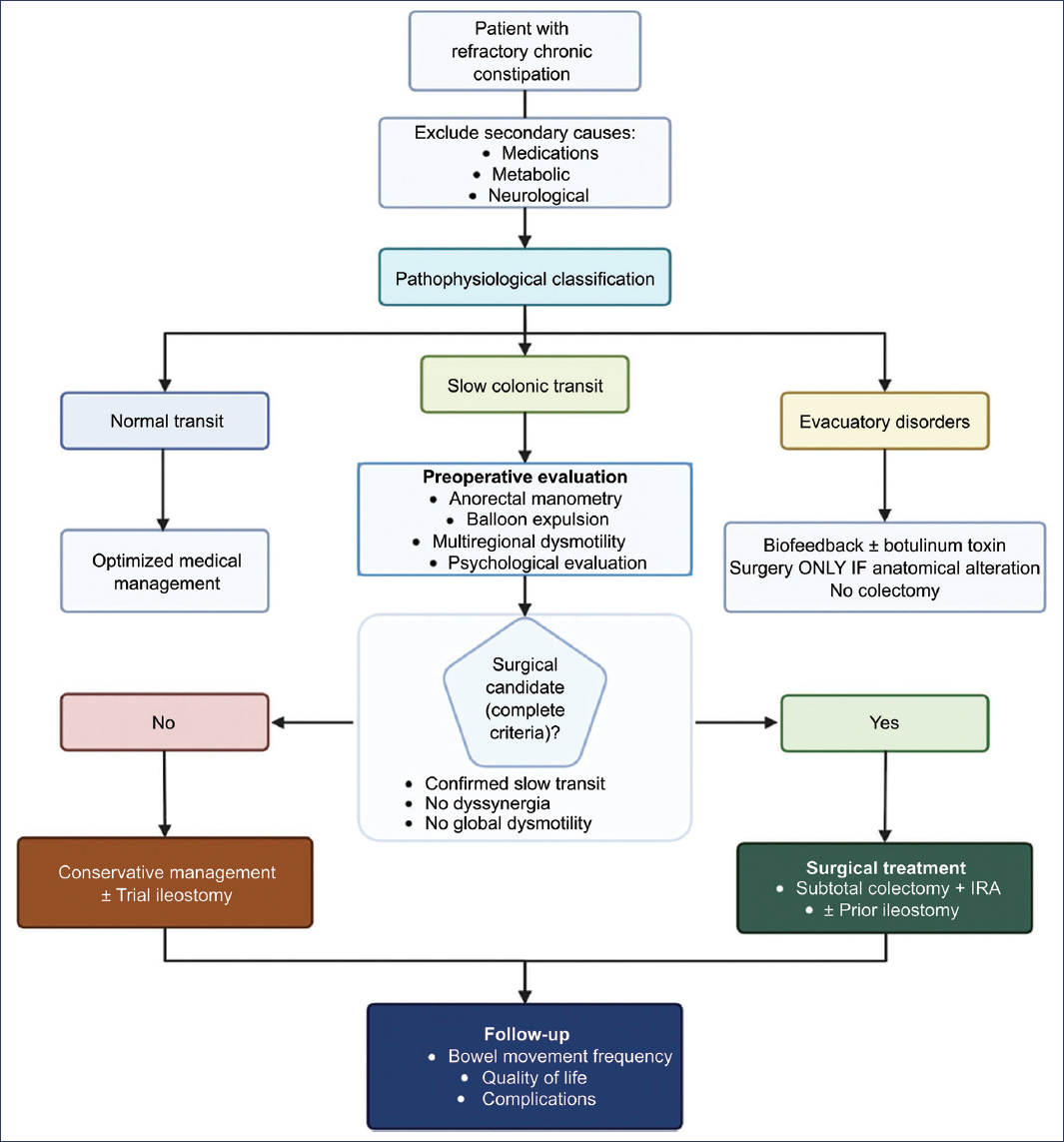
Figure 1. Algorithm for evaluation and selection for surgical treatment of refractory chronic constipation. The diagnostic-therapeutic approach based on the exclusion of secondary causes and pathophysiological classification is summarized. The surgical indication is limited to patients with confirmed slow colonic transit who meet strict clinical and functional criteria. Subtotal colectomy with ileorectal anastomosis (IRA) constitutes the main therapeutic option, while patients who do not meet the criteria should receive conservative management or directed treatment according to their pathophysiology.
Based on the reviewed evidence and current recommendations,1,2,9 a surgical indication may be considered only when the following criteria are simultaneously met:
- –Refractory constipation following a complete trial of medical and non-pharmacological therapies, including biofeedback when indicated and under specialist confirmation of true clinical refractoriness.2,9
- –Objective documentation of slow colonic transit using radiopaque markers or scintigraphy, ideally without concomitant laxative use.1,2
- –Absence of persistent dyssynergic defecation, confirmed by anorectal manometry and balloon expulsion test, or normalization following specific treatment.1,2,9
- –Exclusion of significant multiregional gastrointestinal dysmotility.2,9
- –Preoperative psychological evaluation with controlled comorbidity and no active eating disorders.7
Once the surgical indication has been established according to strict clinical and functional criteria, the choice of technique depends on the pathophysiological phenotype, the extent of the motor disorder, and the individual characteristics of the patient.
The main surgical options for managing refractory chronic constipation include subtotal colectomy with ileorectal anastomosis (IRA), considered the intervention with the greatest support in patients selected following a comprehensive pathophysiological evaluation.
In cases that do not clearly fit the classic categories of slow transit constipation, normal transit, or pelvic floor dysfunction, the use of diverting loop ileostomy has been described as an initial diagnostic-therapeutic strategy to assess clinical response.9 Patients who experience significant improvement following fecal diversion may be considered candidates for colectomy with IRA, with acceptable results in terms of symptomatic improvement and quality of life.10
Segmental resections may be considered in selected scenarios; however, their role is limited and depends strictly on the location and pathophysiology of the motor disorder. When slow colonic transit is diffuse, the evidence suggests that partial resections are associated with a higher risk of symptom persistence, which limits their clinical role.
Sacral neuromodulation, although mentioned in some contexts as an alternative in refractory constipation, does not have sufficient evidence to position it as a primary surgical strategy in this scenario. Consequently, subtotal colectomy with IRA, preceded in selected cases by a loop ileostomy to evaluate clinical response, represents the best-documented surgical strategy for strictly categorized patients with refractory chronic constipation.10
In contrast to strategies targeting slow colonic transit, some surgical interventions do not aim to resect the colon but rather to facilitate bowel emptying in patients with complex defecatory disorders or neurological dysfunction. These techniques act on the evacuatory mechanism rather than on colonic motility. Among them, the Malone procedure, or Malone Antegrade Continence Enema (MACE), is an option used in selected cases.
However, given the objective of this review, the analysis focuses primarily on the surgical treatment of functional chronic constipation associated with confirmed slow colonic transit, emphasizing the importance of strict selection based on objective physiology and a multidisciplinary approach.
Subtotal colectomy with ileorectal anastomosis
Subtotal colectomy with IRA was described as a treatment for refractory chronic constipation in the mid-twentieth century; however, its consolidation as a therapeutic option occurred following the incorporation of physiological tests that allowed differentiation between slow colonic transit and pelvic floor evacuatory disorders, thereby optimizing patient selection.1,11 Currently, the procedure is indicated primarily in patients with severe chronic constipation, refractory to medical treatment, with objectively documented slow colonic transit and without significant pelvic floor dysfunction or structural rectal abnormalities.1,2 Rigorous selection is decisive, as intervention in patients with normal colonic transit or persistent dyssynergia is associated with high rates of functional failure.1
From a technical standpoint, subtotal colectomy with IRA consists of subtotal or total resection of the colon with preservation of the rectum and subsequent ileorectal anastomosis. In the laparoscopic era, aspects such as the preservation of the superior rectal artery to reduce the risk of anastomotic leak have been optimized,12 as has the implementation of minimally invasive approaches, with favorable perioperative outcomes.13 In certain cases, a protective ileostomy may be considered, particularly in patients with risk factors for anastomotic complications.14
Predictors of good and poor outcome
Predictors of good clinical outcome include strict selection of patients with documented diffuse slow colonic transit, absence of pelvic floor dysfunction, and exclusion of motor abnormalities of the upper gastrointestinal tract.1,11 Preoperative physiological evaluation using colonic transit studies and anorectal testing is fundamental for identifying optimal candidates and minimizing the risk of functional failure.1 Likewise, the exclusion of patients with predominant abdominal pain, severe bloating, or complex functional symptoms not attributable exclusively to constipation is key, as these symptoms tend to persist after surgery.1
Among the predictors of poor outcome are the presence of uncorrected evacuatory dysfunction, proximal intestinal dysmotility, complex abdominal symptoms, and absence of improvement following a trial ileostomy.1 Advanced age, significant comorbidity, and a history of multiple abdominal surgeries may also increase the risk of complications and limit functional benefit.15,16
Results and limitations
The literature reports significant improvement in bowel movement frequency and a reduction in laxative use in the majority of patients meeting well-established surgical criteria.11,16 However, the functional impact extends beyond a mere increase in the number of bowel movements. Although constipation may resolve, postoperative diarrhea may occur in 40-46% of cases, fecal incontinence in variable proportions (20-50% depending on the series), and bowel obstruction in 15-40%.1,15,16 Anastomotic leak is reported at approximately 3% in contemporary series.14
In a study published by one of the authors, which included 710 patients with constipation evaluated at two high-specialty referral centers in Mexico City, 8 female patients (1.1% of the total patient population) met the criteria for slow colonic transit constipation refractory to medical treatment and underwent laparoscopic total colectomy with ileorectal anastomosis. The mean age was 38 years (range: 22-62). Conversion to open surgery was required in one case (12.5%). Overall morbidity was 37.5%, including bowel obstruction, anastomotic leak, and internal hernia; no mortality was recorded. From a symptomatic standpoint, significant improvement in abdominal bloating, as well as nausea and vomiting, was observed. Abdominal pain measured using a visual analog scale decreased significantly from 6.6 ± 0.3 preoperatively to 3.6 ± 2.3 after surgery. Regarding functional outcomes, the frequency of bowel movements increased from 0.85 to 6.75 per week, while laxative use decreased from 4.12 to 0.37 dose-days during follow-up. 88% of patients reported symptomatic improvement. Quality of life assessed using the SF-36 questionnaire showed improvement in all domains at one year of follow-up, including physical function, bodily pain, vitality, social function, and mental health, with a high proportion of patients stating they would recommend the procedure.17
These findings reinforce that, in patients with a well-established surgical indication, laparoscopic subtotal colectomy with IRA can offer significant functional benefit and objective improvement in quality of life; however, the complication profile and the risk of persistent functional alterations require thorough preoperative counseling and close follow-up. On the other hand, the available evidence, both international and national, derives primarily from observational series with limited sample sizes, which precludes generalization of the results.1,16,17 Furthermore, a subgroup of patients experiences persistent abdominal pain, need for evacuatory assistance, or deterioration in certain quality-of-life domains compared to the general population.16 Up to 19% may require permanent ileostomy due to functional failure.1,16 These findings underscore that subtotal colectomy with IRA does not constitute a universal solution, but rather an intervention directed at a very specific phenotype.
Comparison with other strategies
Compared with segmental resections, subtotal colectomy with IRA offers significantly superior outcomes, as partial resections in cases of diffuse slow transit are associated with high rates of functional failure.1 Against continent or derivative procedures, such as MACE, IRA has the advantage of eliminating the hypomotile colonic segment, albeit at the cost of greater irreversibility and a risk of alteration in the bowel movement pattern. Likewise, compared with colectomy with ileal pouch-anal anastomosis, IRA preserves the rectum and is generally associated with better continence in patients without rectal disease.18
Overall, subtotal colectomy with IRA continues to be the surgical strategy with the greatest support for documented diffuse slow colonic transit; however, its indication must be reserved for truly refractory cases, following a comprehensive evaluation and with clear information regarding the risks and realistic expectations.1
Segmental resections
Historically, segmental colonic resections were used in the management of chronic constipation before the pathophysiology of colonic motility disorders was more precisely understood. With the development of colonic transit studies, scintigraphy, and manometry, it became evident that chronic constipation due to slow transit usually represents a diffuse motor abnormality rather than a localized defect, which led to subtotal or total colectomy progressively displacing segmental resections as the standard technique in adults.15,16
The discordance between the segmental retention observed in studies using radiopaque markers and the true global neuromiogenic abnormality of the colon explains, in part, the high rates of functional failure following partial resections.15,16 Consequently, limited resection of a colonic segment rarely corrects the underlying pathophysiological defect when diffuse dysmotility is present.
The main segmental resection techniques are partial colectomy, most frequently sigmoidectomy, and right or left hemicolectomy, depending on the supposedly affected segment. In current practice, these interventions are reserved for patients with clearly documented segmental dysmotility via functional studies and without evidence of involvement of the remainder of the colon or the upper gastrointestinal tract.15,16 In the pediatric population, segmental resection may be considered in highly selected cases following the failure of conservative measures and less invasive procedures.19
Contemporary indications are therefore exceptionally restrictive: refractory chronic constipation with isolated segmental dysmotility, absence of evacuatory disorder, and exclusion of global dysmotility.15,16 In adults, subtotal colectomy with IRA continues to be preferred, given that the evidence suggests that the majority of cases are due to diffuse motor abnormalities.15,16
The available evidence on functional outcomes following segmental resections is limited and of low quality, based primarily on small series and retrospective studies.15,16 High rates of symptomatic recurrence, need for reoperation, and progression to subsequent total colectomy have been reported.16 In the pediatric population, outcomes are also variable, and a significant percentage may require permanent ostomy or additional procedures.20,21
Furthermore, when a global intestinal motility disorder is present, segmental resection is contraindicated, as it not only fails to resolve the clinical condition but may also exacerbate symptoms such as bloating and abdominal pain, increasing morbidity and the likelihood of subsequent surgery.15,16
Consequently, in adults with diffuse slow colonic transit, segmental resection should not be considered an equivalent alternative to subtotal colectomy, but rather an exceptional strategy whose indication requires rigorous functional documentation and a detailed discussion of expectations.
Diverting loop ileostomy
Diverting loop ileostomy has been proposed as a reversible diagnostic and therapeutic strategy in the management of refractory chronic constipation in adults, particularly in those cases that do not clearly fit the classic phenotypes of pure slow colonic transit or isolated evacuatory disorders.10 Its pathophysiological rationale lies in the fact that, by proximally diverting fecal transit, it is possible to evaluate whether the predominant symptoms (constipation, bloating, abdominal pain) are due to colonic dysmotility amenable to resection or to a more global motor disorder involving the small intestine, rectum, or complex sensory-visceral mechanisms.
In this context, ileostomy acts as an in vivo functional test. The most recent recommendations consider diverting ileostomy as a reversible diagnostic tool, particularly useful in patients with uncertain surgical indications or relative contraindications to colonic resection, allowing longitudinal assessment of clinical response before an irreversible decision is made.9 Significant symptom improvement following diversion suggests that dysmotility is predominantly colonic and that the patient may benefit from subtotal colectomy with IRA. Conversely, persistence of symptoms despite fecal diversion points toward a multiregional motor disorder or a complex functional component, which argues against a definitive resection.10
In accordance with current recommendations, its indication should be considered only following a thorough functional evaluation and documented failure of medical and non-pharmacological treatment.1,9 It is reserved for patients with refractory chronic constipation in whom doubts persist regarding the true extent of the motor disorder, or when complex symptoms exist (predominant abdominal pain, severe bloating) that do not fully correlate with isolated slow colonic transit.10
In the most relevant contemporary series, approximately two-thirds of patients experienced clinical improvement following ileostomy, including a reduction in laxative use and a subjective improvement in quality of life.10 Among those who showed a favorable response, a significant proportion maintained the improvement following definitive colectomy, supporting its usefulness as a surgical selection tool. Likewise, ileostomy allowed resections to be avoided in patients who did not demonstrate initial clinical benefit, thereby reducing the risk of irreversible interventions with a high probability of functional failure.10
Nevertheless, loop ileostomy is not without complications. Like any ostomy, it may be associated with dehydration, parastomal hernias, retraction, or the need for surgical revisions. Furthermore, it carries a relevant psychosocial impact that must be thoroughly discussed with the patient before its implementation.1 Therefore, its indication must be integrated into a multidisciplinary algorithm with clearly established expectations.1,9
In summary, diverting loop ileostomy does not constitute a definitive treatment for refractory chronic constipation, but rather a strategic and reversible tool that allows the selection of candidates for subtotal colectomy to be refined in pathophysiologically uncertain scenarios.10 Its prudent use may reduce the number of unnecessary colectomies and improve precision in surgical decision-making.
Malone Procedure (MACE)
The MACE consists of the surgical creation of a continent appendicostomy that allows the periodic administration of antegrade enemas directly into the cecum via catheterization.22
The antegrade continence enema was described in 1989 and published in 1990 in The Lancet, combining the principles of antegrade colonic lavage and the non-refluxing catheterizable channel of Mitrofanoff.22 In its original description, the procedure was proposed as an alternative for managing intractable fecal incontinence, particularly in the pediatric population with complex neurological pathology.22 Subsequently, its indication was extended to the treatment of refractory chronic constipation and other severe defecatory disorders, both in the pediatric and adult populations.23,24
Technically, the appendix is mobilized and anastomosed to the abdominal skin, generally in the umbilical region or in the right lower quadrant, creating a continent conduit that allows intermittent catheterization. When the appendix is unavailable or insufficient, alternatives such as the construction of a continent conduit using an ileal or cecal segment, or combined techniques with other catheterizable channels, may be employed.25,26
In addition to the classic Malone procedure, there are technical variants that allow antegrade irrigation through the creation of a continent conduit, including appendicostomy, cecostomy, and neo-appendicostomy. These techniques are described as adjuncts in the management of fecal incontinence and refractory constipation, particularly in the pediatric population and in patients with neurological disease.27,28
The purpose of MACE is to facilitate colonic emptying in patients with severe defecation disorders, including refractory chronic constipation and fecal incontinence, especially in contexts of neurological dysfunction, such as myelomeningocele or spinal cord injury.26,27
In the adult population, the most frequent indications include neurological disease, severe refractory idiopathic constipation, and complex surgical histories that limit other therapeutic options.23,24
The first clinical series documented improvement in continence and bowel movement frequency in patients with neurological pathology.26–28
In the study by Poirier et al.,29 18 patients with severe defecatory disorders were evaluated using a 15-question questionnaire on use, function, and self-reported outcomes, and it was concluded that 78% of patients had a successful functional outcome. These findings contributed to positioning MACE as a valid alternative to colonic resection in selected patients.
Contemporary series and systematic reviews report success and satisfaction rates ranging from 60% to 83% in adults, with improvement in bowel movement frequency and quality of life.23,24,29,30 In broader analyses of surgical interventions for defecatory disorders, MACE is described as a useful alternative in well-selected phenotypes, although it depends on a prior comprehensive functional evaluation.31
However, minor complications are relatively frequent and include stoma stenosis, fecal leaks, local infections, and the need for surgical revisions.24,25,30
From a comparative standpoint, MACE represents a continent and potentially reversible strategy that can avoid extensive colonic resections in patients with complex evacuatory disorders. However, its efficacy depends on adequate distal colonic function and rigorous patient selection, and therefore it does not substitute for subtotal colectomy with IRA in documented diffuse slow colonic transit.23,31
Consequently, the Malone procedure should be reserved for patients with well-defined pathophysiological phenotypes, particularly in neurological contexts or in refractory constipation with a predominant evacuatory component, and always following a thorough multidisciplinary evaluation.
Sacral neuromodulation
Sacral neuromodulation consists of chronic electrical stimulation of the sacral nerve roots, typically at the S3 level, via an electrode implanted in the sacral foramen and connected to a subcutaneous generator. Its physiological rationale lies in the modulation of spinal and supraspinal reflex circuits involved in the regulation of continence and anorectal function. In the context of constipation, it has been proposed that it could influence distal colonic motility, rectal sensitivity, and evacuatory coordination; however, the available physiological studies are limited and heterogeneous, and do not consistently demonstrate objective modification of colonic transit.32–34
Although sacral neuromodulation is indicated for refractory fecal incontinence, there is no formally accepted indication for its use in chronic constipation. The guidelines of the American College of Gastroenterology and specialized reviews agree that the current evidence does not support recommending sacral neuromodulation as a standard treatment for any subtype of constipation, including slow transit and evacuatory dysfunction.31,33
The highest-level methodological evidence is predominantly negative. The most recent meta-analysis of randomized controlled trials showed no significant benefit in symptomatic improvement or quality of life compared to placebo or conservative treatment.35 Consistently, previous systematic reviews and critical analyses of randomized controlled trials highlight the absence of clinically relevant improvement and the substantial heterogeneity in diagnostic criteria, definition of response, and duration of follow-up.31,34,36
Individual controlled trials reinforce these findings. In a pilot study conducted by Iqbal et al.,37 transcutaneous sacral stimulation administered for 4 weeks (12 hours daily) in 16 patients with chronic constipation did not demonstrate significant short-term clinical efficacy, as assessed using validated scales such as the Patient Assessment of Constipation-Symptoms (PAC-SYM), the Patient Assessment of Constipation Quality of Life (PAC-QOL), and the Cleveland Constipation Tool. Likewise, in a double-blind sham-controlled trial published in 2019, a high rate of initial response attributable potentially to the placebo effect was observed, with only 18% of clearly discriminative responders. The study was terminated early due to a high rate of infections, which limited definitive conclusions regarding overall efficacy.38
Additionally, cost-effectiveness analyses do not favor neuromodulation over conservative treatment in patients with idiopathic slow transit.36 Complications are not negligible: infection rates of up to 22% have been reported, along with electrode migration or malfunction, pain at the implant site, and reoperation rates that may reach 29%, with device-related adverse events described in up to 61% in prolonged follow-up.33,36
Consequently, sacral neuromodulation does not correct the underlying colonic motor abnormality in diffuse slow transit, nor does it consistently modify objective parameters of intestinal function. Its use could only be considered in highly selected, off-label scenarios, following the failure of all conservative measures and with detailed information regarding the limited probability of response and the significant risk of complications.31,36
It is not indicated for constipation secondary to metabolic, neurological, or pharmacological causes, nor in patients with uncontrolled psychiatric disorders or correctable anatomical abnormalities. In the pediatric population, its use should be strictly restricted to research protocols.4,33
In summary, the current evidence from clinical trials and meta-analyses does not support sacral neuromodulation as a standard therapy for refractory chronic constipation, and its role remains controversial within the contemporary therapeutic algorithm.
Other surgical techniques and interventions in chronic constipation
Beyond subtotal colectomy with IRA, diverting ileostomy, the Malone procedure, and sacral neuromodulation, other surgical and invasive interventions have been described for the management of chronic constipation, particularly in refractory scenarios or those associated with specific anatomical abnormalities.
Percutaneous endoscopic colostomy
Percutaneous endoscopic colostomy consists of the endoscopic placement of a tube in the colon that allows antegrade irrigation. It has been proposed as a minimally invasive alternative in patients with severe refractory constipation who are not candidates for major surgery.
Wilkinson-Smith et al.39 describe it as a rescue therapeutic option with limited evidence, supported primarily by case series and expert opinion. Although it may avoid a formal surgical colostomy in frail patients, its long-term efficacy and safety are not well established.
Transanal irrigation
Transanal irrigation allows scheduled mechanical emptying of the distal colon and is used especially in patients with evacuatory disorders or refractory constipation. Within contemporary therapeutic algorithms, it is positioned prior to consideration of major colonic resections.39 In the pediatric population, the recommendations of the North American Society for Pediatric Gastroenterology, Hepatology, and Nutrition (NASPGHAN) recognize it as an intermediate strategy following the failure of conservative measures.19
Surgical procedures for defecatory disorders and outlet obstruction
In contrast to diffuse slow colonic transit, these procedures are directed at anatomical abnormalities of the rectum or the posterior pelvic compartment, and their indication requires strict correlation between clinical findings and functional or radiological studies.
STARR (Stapled Transanal Rectal Resection)
The STARR procedure is indicated in patients with obstructive defecation syndrome secondary to rectal intussusception or rectocele. Levitt et al.40 report improvement in constipation scores in selected patients. However, its indication is not justified in diffuse slow colonic transit, as noted in the recommendations of the American Society of Colon and Rectal Surgeons (ASCRS).1
Delorme procedure
The Delorme procedure, which consists of a rectal mucosectomy with muscular plication, is used in internal intussusception and partial rectal prolapse. When the indication is established with precise anatomical criteria, it can achieve symptomatic improvement with acceptable recurrence rates.1
Ventral mesh rectopexy
Ventral mesh rectopexy is used for rectal intussusception and rectocele, restoring rectal anatomy without extensive posterior resection. In patients with documented anatomical abnormalities, this approach can improve both obstructive symptoms and incontinence episodes.1
Rectopexy (including associated sacrocolpopexy)
In cases of complete rectal prolapse or complex abnormalities of the posterior pelvic compartment, rectopexy, sometimes combined with sacrocolpopexy, can correct anatomical causes of secondary constipation. Both the ASCRS and the American Gastroenterological Association (AGA) agree that surgical intervention should be reserved for patients with objective structural abnormalities and consistent symptomatic correlation.1,41
Botulinum toxin
In patients with pelvic floor dyssynergia refractory to biofeedback, injection of botulinum toxin A has been used as a temporary measure to reduce functional obstruction. However, the American College of Gastroenterology considers that the evidence is limited and that this strategy should not replace behavioral therapy with biofeedback as first-line treatment.33 Consistently, the AGA classifies it as a second-line intervention with insufficient scientific support for routine use.41
Appendicostomy, cecostomy, and neo-appendicostomy
In addition to the classic Malone procedure, there are technical variants that allow antegrade irrigation through the creation of a continent conduit. Halleran et al.27 describe these techniques as adjuncts to the management of fecal incontinence and refractory constipation, particularly in the pediatric population and in patients with neurological disease. NASPGHAN recommendations support their use in selected cases following the failure of conservative therapies.19
Anorectal myectomy
Anorectal myectomy may be considered in highly selected situations, particularly in short-segment Hirschsprung’s disease in adults. Outside of this specific indication, it has not demonstrated consistent efficacy in other forms of chronic constipation.42
Discussion
The present work demonstrates that the surgical indication in chronic constipation continues to be an exceptional clinical scenario, in which appropriate pathophysiological characterization is the main determinant of outcomes. Despite the high prevalence of functional constipation, only a very specific subgroup of patients with refractory slow colonic transit benefit from surgical intervention, which underscores the importance of a comprehensive and standardized evaluation.
Likewise, the heterogeneity in diagnostic criteria, variability in patient selection, and the predominance of observational studies limit the comparability of results reported in the literature. This explains, in part, the different functional outcomes and variable patient satisfaction. In this context, the integration of clinical, functional, and psychosocial criteria within a multidisciplinary approach constitutes a key element for optimizing decision-making and reducing the risk of unnecessary interventions.
Conclusion
Surgery for chronic constipation should be reserved for appropriately selected patients, particularly those with confirmed refractory slow colonic transit constipation established through objective physiological evaluation. Subtotal colectomy with IRA is the option with the greatest support in this group, while other interventions have specific indications or limited evidence. Appropriate patient selection continues to be the primary determinant of outcomes.
Funding
The authors declare that no funding was received for this study.
Conflicts of interest
The authors declare no conflicts of interest.
Ethical considerations
Protection of persons and animals. The authors declare that no experiments were performed on human beings or animals for this research.
Confidentiality, informed consent, and ethical approval. The study does not involve personal data, medical records, or human biological samples; therefore, ethical approval is not required. The SAGER guidelines do not apply.
Statement on the use of artificial intelligence. The authors declare that no type of generative artificial intelligence was used for the writing or content creation of this manuscript.
